
Cooperative societies have helped many Nigerians save money, buy land, pay school fees and access loans…
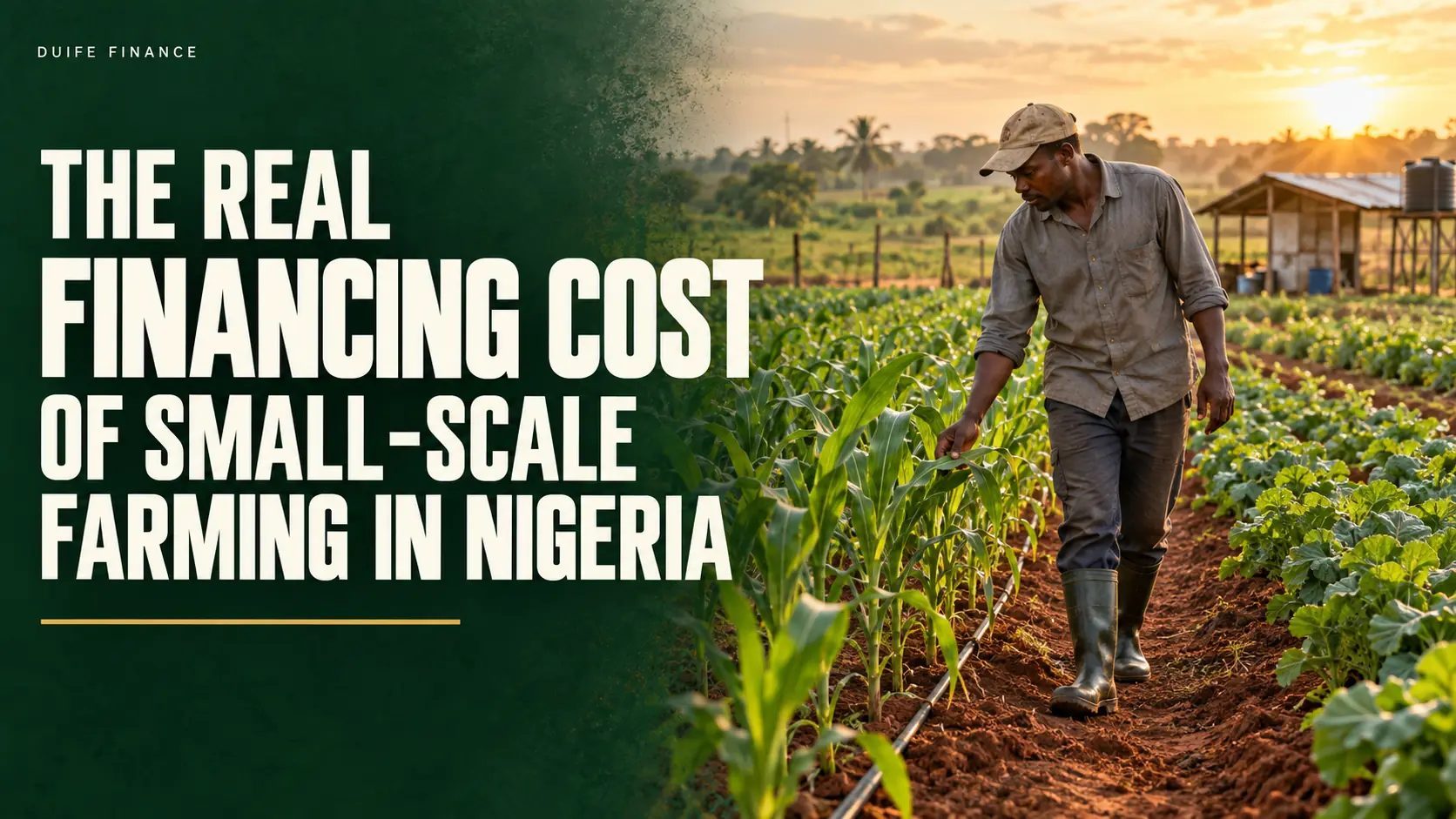
The Real Financing Cost of Small-Scale Farming in Nigeria
Small-scale farming in Nigeria is often presented as a simple route from land to profit. Someone calculates the price of seed, fertiliser and chemicals, adds an estimate for labour, and concludes that a farmer only needs a modest loan to begin. The calculation usually looks convincing until the farming season starts. Money arrives late, input prices move, transport costs rise, rain changes its pattern and buyers begin to dictate prices. By the time the farmer repays the loan, the real cost of the finance may be far higher than the interest written on the first page. This gap between the advertised rate and the farmer’s actual burden is where many promising farms begin to struggle.
I have found that people ask the wrong first question when comparing agricultural loans. Most ask only for the interest rate instead of asking how much usable money will reach the farm, when it will arrive and what must be repaid. The broader question captures interest, fees, compulsory deposits, insurance, documentation, travel, delayed planting and poor sale terms. It also forces the farmer to consider the repayment schedule rather than admiring a low rate. A nine percent facility can be expensive when its timing and conditions damage the production plan. A higher-rate facility can sometimes be less harmful if it arrives on time, allows flexible sales and matches the crop cycle.
Access to formal farm credit remains limited in Nigeria. The Central Bank of Nigeria states that less than five percent of bank credit goes to agriculture, even though the sector supports millions of households. Lenders see risks that are easy to understand, including weather, disease, weak records, uncertain land rights, price swings and the long wait between planting and harvest. Farmers see a different risk, which is that the money needed today may arrive after the useful planting window has passed. Both sides are responding to real problems. The result is that many small farmers borrow from cooperatives, produce buyers, input dealers, relatives and informal lenders instead of using a normal bank loan.
The headline interest rate is still important, but it must be translated into naira. Suppose a farmer borrows ₦1 million for eight months at an annual rate of 18 percent calculated on a flat basis. The stated interest for eight months would be ₦120,000 before any other charge. If the lender deducts a processing fee, insurance and account charges before releasing the money, the farmer may receive less than ₦1 million while interest is still calculated on the full principal. That difference raises the true rate paid on the cash actually available for farming. A borrower should therefore ask whether interest is calculated on the original amount, a reducing balance or another basis.
Flat-rate interest and reducing-balance interest are not the same thing. Under a flat calculation, interest continues to be based on the original principal even as instalments reduce what the farmer owes. Under a reducing-balance method, interest is charged on the outstanding amount, so the interest portion should fall as principal is repaid. Two lenders can advertise the same annual rate and produce different total repayments because their calculation methods differ. The repayment schedule should show each instalment, the interest inside it and the remaining principal. If a lender cannot provide that schedule before signing, the farmer does not yet know the price of the loan.
Loan fees can quietly add several percentage points to the cost. A lender may charge for application, processing, management, credit checks, account maintenance, valuation, legal work, inspection or documentation. Not every facility contains all these charges, and a farmer should not assume that a fee mentioned by one bank applies everywhere. The correct step is to request a written list of every compulsory payment from application to final discharge. Fees deducted upfront are particularly important because they reduce the amount that enters the farm. Paying interest on ₦1 million after receiving only ₦940,000 is not the same as receiving and using the full ₦1 million.
Compulsory savings and lien deposits create another cost that is easy to miss. The Bank of Agriculture’s published micro-loan requirements, for example, include a 20 percent lien deposit and a minimum banking relationship before application. A lien deposit may remain the borrower’s money, but it is money the farmer cannot use freely during the period it is tied down. A person requesting ₦1 million may need to find ₦200,000 before the loan can move, depending on the applicable product. That cash could have bought seed, paid land preparation or covered an emergency. Its value as blocked working capital should be included when comparing the facility with another option.
The cost of meeting loan conditions can also be substantial in rural areas. A farmer may travel several times to a branch, obtain passport photographs, print bank statements, register a cooperative, prepare a business plan and pay for affidavits or land documents. A guarantor may have to leave work to sign forms or supply records. Some agricultural credit arrangements require farm mapping, tagging and site inspection, with at least part of that cost borne by the customer. Each item may look small when considered alone. Together, they can consume money and time before the first bag of fertiliser reaches the field.
Government guarantees are often misunderstood as protection for the farmer. Under the Agricultural Credit Guarantee Scheme Fund, the Central Bank guarantees part of qualifying agricultural credit provided by participating banks. The published scheme covers 75 percent of the net amount in default after security is realised. That guarantee encourages the bank to lend, but it does not cancel the borrower’s debt. The Central Bank’s guidance states that a claim paid to the lending bank is not credited as a benefit to the farmer, who remains liable for the total indebtedness. A farmer should never default deliberately because a loan officer described the facility as government-guaranteed.
An interest rebate also needs careful reading. The Agricultural Credit Guarantee Scheme includes an Interest Drawback Programme that can reimburse 40 percent of the interest element on eligible loans. However, the customer generally qualifies only after repaying the principal and interest within the agreed period, subject to the scheme’s conditions. This means the farmer must first survive the season and make the required payments before receiving the benefit. The rebate should therefore not be treated as cash available for planting. Until it is approved and received, the farm plan should remain able to stand without it.
Agricultural insurance is another financing cost, but it should not be dismissed as wasted money. A lender may require cover because drought, flood, fire, disease or another event can destroy the farm while leaving the loan outstanding. The Nigerian Agricultural Insurance Corporation states that selected subsidised crop policies require farmers to pay half of the premium, with government covering the other half. Even with a subsidy, the farmer’s portion must enter the budget. The policy wording, covered crops, insured value, exclusions, reporting period and claims procedure matter as much as the premium. Cheap cover that does not match the actual farm can leave both the crop and loan exposed.
Insurance does not remove the need for working capital after a loss. A claim has to be reported, assessed and approved, which takes time. Meanwhile, a poultry farmer may need to feed surviving birds, and a crop farmer may need money to replant. The loan repayment date may also arrive before a claim is settled. A prudent borrower should ask the lender what happens to instalments while a valid insurance claim is being processed. If the answer is unclear, the farmer should keep an emergency reserve instead of assuming the insurer will solve every cash problem immediately.
Timing can be more expensive than interest in seasonal farming. Maize planted late because loan approval dragged into the rainy season may produce a weak yield even when every input was finally purchased. A vegetable farmer who misses a favourable market window can harvest when supply is high and prices are low. A poultry farmer who receives money after the planned stocking date may face a different feed-price cycle and festive market. The cost of delay is the profit lost because the money was unavailable when it had its highest value. This cost rarely appears on the loan statement, but it appears clearly in the final farm account.
Inflation during the approval period can also shrink a loan before it is disbursed. A budget prepared when fertiliser costs one amount may be useless if the price rises before approval. The farmer then has three bad choices: reduce the cultivated area, use fewer inputs than the crop requires or find additional money at a more expensive rate. Each choice can weaken the expected return. Borrowing the original amount does not mean the farm remains fully funded. A loan that covers only 70 percent of the revised need can become more dangerous than no loan if the reduced investment cannot produce enough to repay it.
Foreign exchange movements enter the cost even when a farmer never buys dollars. Poultry feed ingredients, agrochemicals, machinery parts, irrigation equipment, packaging and improved seed can contain imported components. When the naira weakens, suppliers may reprice those goods quickly. A fixed loan approved in naira then buys fewer inputs than the farmer expected. The farmer bears the gap unless the lender adjusts the facility, which is uncommon after approval. A realistic budget should include a price contingency instead of using the last market quotation as if it will remain unchanged.
Informal credit often looks easier because the lender asks for fewer documents. A produce buyer may provide seed and chemicals on the condition that the farmer sells the harvest back to that buyer. The agreement may carry no interest rate on paper, yet the repayment price for the produce may be well below the open-market price. That lost price is the finance charge. If a farmer gives up ₦150,000 of market value to obtain ₦600,000 worth of inputs, the cost is real even without the word “interest.” Every tied-credit arrangement should show the input value, required quantity, quality standard and formula for setting the final produce price.
Input dealers can also hide finance costs inside the sale price. A bag of fertiliser sold for ₦55,000 cash may be supplied on credit for repayment equivalent to ₦70,000 after harvest. The ₦15,000 difference is the credit cost, even if the dealer calls it a seasonal price rather than interest. Quality is another concern because fake or poor inputs can reduce output while the full debt remains. The farmer should compare the credit price with the cash market price on the same day. If the dealer also controls where the produce must be sold, both sides of the arrangement need to be valued.
Cooperative finance can be fairer, but membership does not make it automatically cheap. The cooperative may require registration fees, shares, monthly savings, development levies, insurance and a percentage deducted into a reserve. Some of those payments build the member’s assets, while others are non-refundable costs. A borrower may also need other members to guarantee the loan and could lose social standing if repayment fails. Where the cooperative uses joint liability, one member’s default can affect the savings or borrowing ability of others. The total contribution tied up and the rules for withdrawal should be considered alongside the stated interest rate.
Digital and informal short-term loans are especially dangerous for farming cycles. A loan due in seven, fourteen or thirty days cannot be sensibly repaid from maize that will mature months later. The farmer may begin rolling one loan into another, paying penalties and borrowing to service interest before the crop is ready. That is not working capital anymore. It is a debt chain funded by hope. Unless another reliable income source will make the short instalments, the repayment frequency must match the farm’s cash flow.
Repayment structure matters as much as repayment length. Crop farming often produces one or two large cash inflows, while eggs, milk, vegetables and processed foods may produce smaller weekly inflows. A monthly instalment may suit an established layer farm but put pressure on a rain-fed rice farmer before harvest. A bullet repayment after harvest may fit the rice cycle, but it creates one large obligation at a time when market prices can disappoint. The schedule should reflect the actual production and sale pattern, not a generic calendar. Farmers should present honest cash-flow estimates instead of changing figures simply to obtain approval.
A grace period is useful only when it covers the period before the farm can generate cash. Three months may sound generous, but it is inadequate for some livestock or tree-crop projects. Even a broiler operation needs time for preparation, stocking, rearing, sale and payment collection. If the first instalment falls due before customers pay, the farmer may divert money meant for feed or veterinary care. That diversion can reduce output and make the next instalment harder. The right grace period is linked to the production cycle and a realistic marketing period.
Market risk is part of financing cost because debt fixes an obligation while produce prices remain uncertain. A farmer may project a maize price of ₦700,000 per tonne and later meet a market offering much less at harvest. Selling immediately may cover the loan but destroy the expected profit. Storing the produce could improve the price, but storage, security, drying, handling and interest continue to cost money. A lender that insists on immediate repayment can remove the farmer’s ability to wait. The cost of finance therefore includes any loss caused by being forced to sell at the worst point in the market.
Structured finance through an aggregator can solve some of these problems. The Bank of Agriculture’s 2026 smallholder programme with WACOT, for example, combined inputs, extension support, off-take and a single-digit loan through an accredited aggregator. Its published terms described input packages of about ₦500,000, a nine percent rate and a nine-month repayment period. That arrangement may be valuable because the farmer receives more than cash. The buyer and technical support can reduce risks that a normal cash loan leaves with the farmer. Still, the farmer should ask who prices the input package, how the produce price will be determined, what quality deductions apply and whether sales outside the arrangement are restricted.
A guaranteed buyer is only useful when the purchase terms are fair and enforceable. The off-taker may provide a floor price, a market-linked price or a price announced near harvest. Those three arrangements expose the farmer to different risks. The contract should explain moisture standards, rejected quantities, weighing, transport, storage and when payment will reach the farmer. A good yield does not pay a loan until the buyer pays for the crop. Delayed payment after delivery can create an extra interest or penalty cost that the farmer did not cause.
Collateral introduces costs even when the farmer never loses it. Property valuation, legal searches, perfection, consent and insurance may be required before a lender accepts land or a building. The borrower may spend this money without any assurance that final approval will follow. Family land can create an additional problem because the individual farmer may use it but lack documents showing a transferable legal interest. A guarantor backed by property may demand compensation or impose conditions. The emotional cost of risking a family asset should not be ignored simply because it has no line in the bank’s offer letter.
Credit history is becoming more relevant to agricultural borrowing. Participating lenders under formal schemes may check credit bureaus and the Central Bank’s Credit Risk Management System before approving a facility. A previous unpaid consumer or business loan can therefore block a useful farm loan. Farmers should review existing debts and correct genuine reporting errors before the planting season begins. They should also ensure that a repaid agricultural facility is reported correctly. A clean repayment record can lower future access costs even when it does not reduce the current interest rate immediately.
The farmer’s own money has a cost as well. Using ₦500,000 from a shop, salary or family savings for the farm means that money cannot serve its former purpose during the season. This is called opportunity cost, but the idea is simple even without the formal name. If the shop would have earned ₦80,000 with lower risk, the farm must do more than return the original ₦500,000 to justify the transfer. Family labour should also be valued instead of being recorded as free. A business that appears profitable only because nobody prices the owner’s time is weaker than the notebook suggests.
Household emergencies can turn cheap agricultural finance into expensive debt. School fees, illness, rent and food do not wait because farm money is sitting in an account. When a borrower diverts part of the loan to a family need, the farm may become underfunded and still owe the full amount. Later, the farmer may take a costly emergency loan to finish production. The original facility then carries a second layer of debt that was never in the plan. Farm funds should be separated from household money, while a modest family reserve is kept outside the production account where possible.
Small farmers also need to price security and leakage. Theft of chemicals, fuel, harvested produce or livestock can remove assets bought with borrowed money. Poor record-keeping can allow workers, agents or even family members to take small amounts that become significant over a season. The lender will not reduce the loan balance because ten bags disappeared from the store. Simple stock records, controlled access and regular counts are therefore part of protecting borrowed capital. The cost of basic security may be lower than the cost of financing stolen inputs twice.
An honest farm budget should have at least three columns in the farmer’s notebook. The first is the production cost, including inputs, labour, land, water, transport, storage and expected losses. The second is the finance cost, including interest, fees, insurance, compulsory deposits, documentation and repayment-related expenses. The third is the timing column, showing when every amount must be paid and when farm income is reasonably expected. This last column reveals cash gaps that a simple profit calculation hides. A profitable season on paper can still default when money enters two months after the instalment is due.
I would also test the plan against a bad but believable season. Reduce expected yield, reduce the selling price and increase one major input cost. Then check whether the farm can still repay without selling essential household property. This is not pessimism. It is a way to measure how much disappointment the business can carry. If one small change destroys repayment capacity, the proposed loan is too large, too short or attached to the wrong project.
The most useful figure is the total naira cost of obtaining and closing the loan. Start with all repayments, then add fees, insurance, travel, professional charges and the cost of tied-up deposits. Add any price discount imposed by an off-taker and any extra expense caused by delayed disbursement. Compare that sum with the actual cash and inputs received by the farm. Divide the cost by the usable amount and adjust for the length of the facility if you need an annual comparison. This calculation will not be perfect, but it is more honest than repeating the advertised rate.
Before signing, a farmer should ask the lender direct questions and insist on clear answers. How much will enter my account, which amounts will be deducted, when will disbursement happen, and what is the total repayment in naira? What happens if rain delays planting, the buyer pays late or an insured loss occurs? Can I repay early without a penalty, and is there a rebate for good performance? Who controls the sale of my produce and how will its price be fixed? If these answers are absent from the written documents, a friendly promise from a loan officer is not enough.
Records improve both farming decisions and future access to finance. Keep receipts for inputs, labour, transport, insurance and every loan payment. Record the quantity harvested, the amount lost, the selling price, the buyer and the date payment arrived. Separate cash sales from credit sales and household withdrawals. At the end of the season, compare the actual figures with the original plan. A farmer with reliable records can reject a bad facility quickly and present a stronger case to a better lender.
Cheap finance works best when it comes with the other things the farm needs. Quality inputs, extension advice, storage, insurance and a credible buyer can be worth more than a small reduction in interest. This is why some structured programmes may outperform a cash loan even when the paperwork is heavier. The support must still be valued honestly because a package can contain overpriced inputs or restrictive sales conditions. Farmers should join cooperatives or clusters that negotiate transparently and publish the terms to members. Group power is useful only when leaders remain accountable.
My view is that a small-scale farmer should borrow for a proven production plan, not for an attractive programme name. Start with a size that can be supervised properly and repaid under conservative assumptions. Match the loan to the crop or livestock cycle, protect it with suitable insurance and avoid using short-term digital credit for long biological processes. Keep some money outside the farm for household emergencies and production surprises. Do not count a government guarantee, rebate or expected grant as cash until it is actually available. The best farm loan is not the one with the lowest headline rate, but the one the farm can use on time and repay without destroying itself.
Small-scale farming can produce real income, but debt removes room for careless estimates. Interest is visible, while delay, tied deposits, insurance, poor sale terms and cash-flow pressure often remain hidden until harvest. Once those hidden items are priced, some loans will still make sense and others will not. A farmer who rejects an unsuitable loan has made a financial decision, not missed an opportunity. A farmer who accepts a suitable facility should monitor every naira from disbursement to final repayment. That discipline is what turns finance into productive capital instead of another burden carried from one farming season to the next.
Disclaimer: This article provides general financial information and does not replace advice based on a farmer’s crop, location, lender and contract. Rates, subsidy programmes, insurance terms and loan requirements can change. Confirm every current condition with the lender, insurer and programme administrator before paying a fee or accepting a facility. Never submit false records or divert a restricted agricultural loan to another purpose. Read the offer letter, repayment schedule, insurance policy and off-take agreement together because each document can change the real cost. In farming, the cheapest-looking money is not always the cheapest money to use.
More to Explore

Comments (0)