
One of the hardest things about earning a salary in Nigeria is that the number can…
School Fees Inflation vs Salary Growth in Nigeria
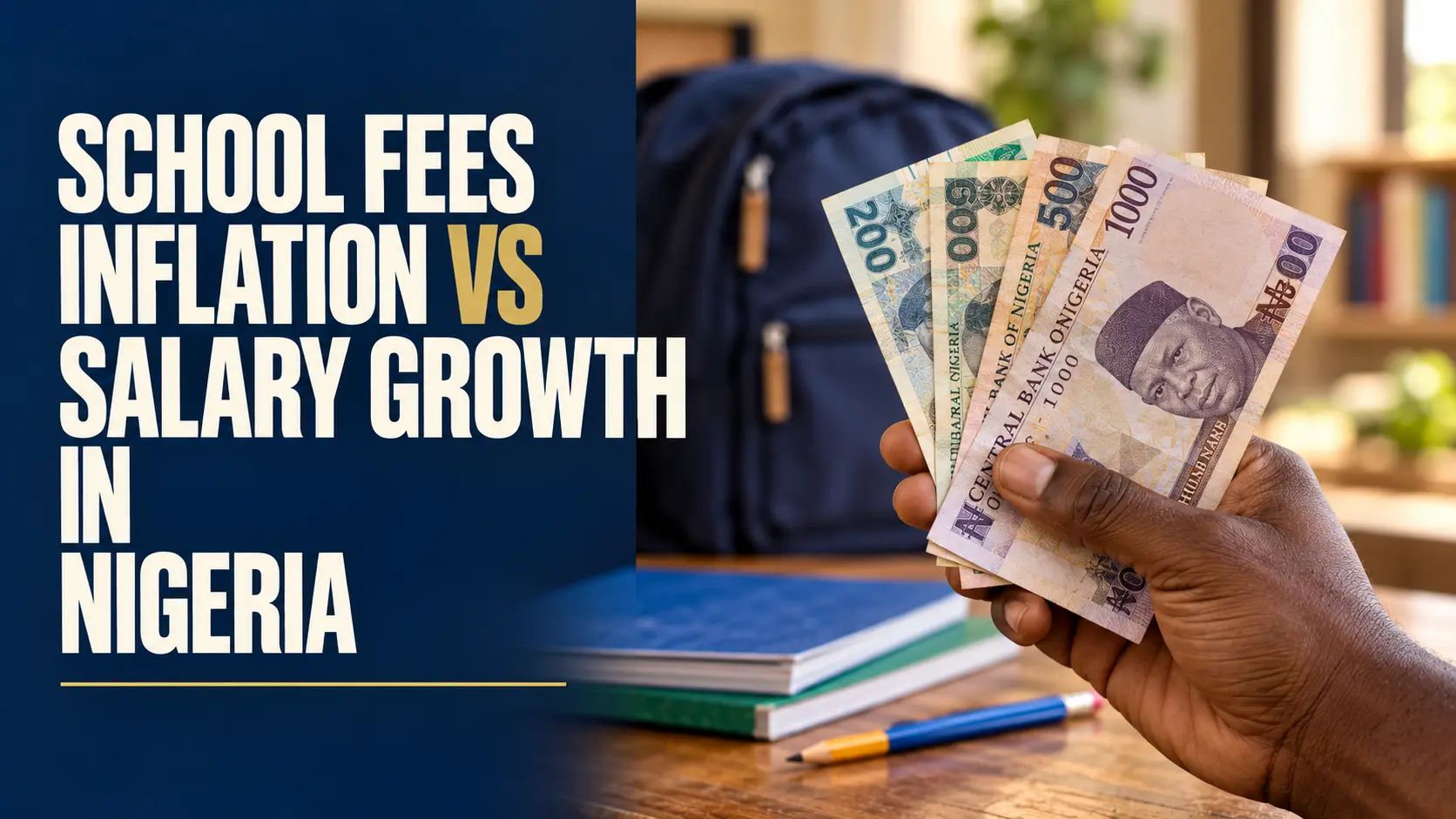
For many Nigerian parents, the beginning of a school term now feels like the arrival of a major debt. The school sends a new fee schedule, transport costs have increased, textbooks have changed, and at least one extra levy has appeared. Meanwhile, the parent’s salary may be exactly what it was twelve months ago. Even when an employer approves a raise, the increase is often too small to match the new education bill. This is the problem at the centre of school fees inflation in Nigeria.
School fees inflation means that the total cost of educating a child rises from one period to another. Salary growth measures how much a worker’s pay rises during the same period. A family is financially better off only when income grows fast enough to cover the higher cost of education and other essential expenses. A salary increase can look good on paper while the family’s real position becomes worse. What matters is not the size of the raise alone, but what the new salary can still pay for.
There is no single school fees inflation rate that describes every Nigerian family. A low-cost private school in Ilorin will not charge the same amount as a school in Lekki, Abuja or Port Harcourt. Government schools, faith-based schools, international schools and neighbourhood private schools also have different cost structures. Some schools raise tuition once a year, while others introduce smaller increases through transport, books, meals, uniforms and development levies. The inflation experienced by a parent is therefore based on the actual school and services the family uses.
The National Bureau of Statistics measures changes in the prices of goods and services through the Consumer Price Index. The CPI was rebased using 2023 household expenditure weights and a 2024 price reference period so that the basket would better reflect current spending patterns. This national measure is useful, but it remains an average drawn from many households and locations. Your child’s school can raise its fees much faster than the education component of the national index.
Salary growth also needs careful interpretation. If a worker’s monthly salary rises from ₦250,000 to ₦275,000, the nominal increase is 10 per cent. That does not mean the worker has become 10 per cent better off. If food, rent, transport, electricity and education costs rise by more than 10 per cent, the worker’s real income has fallen. The payslip is larger, but the household can afford less.
The International Labour Organization describes real wage growth as wage growth after the effect of price increases has been considered. Its wage reports examine the gap between nominal earnings and workers’ actual purchasing power. This distinction explains why many Nigerian workers receive salary increases without feeling any relief. A raise that does not keep pace with living costs is partly an adjustment for lost purchasing power, not a genuine improvement in wealth.
Nigeria’s national minimum wage was increased to ₦70,000 in 2024, with the government stating that it would be reviewed after three years. The increase was significant in percentage terms compared with the previous minimum wage. However, a large percentage increase from a low base can still leave a worker unable to meet basic family expenses. In many cities, one child’s termly private-school bill can exceed several months of minimum-wage income. The minimum wage is also a legal floor, not a measure of what every employer pays or how quickly salaries rise.
Private employers do not automatically adjust salaries whenever inflation rises. A company facing higher fuel, electricity, rent, tax and borrowing costs may also be struggling to protect its profit. Some employers freeze salaries, reduce bonuses or delay promotions during difficult periods. Others approve a small general increase that is far below the rise in household expenses. Workers then carry the difference through reduced savings, debt or lower living standards.
Schools face many of the same costs as other businesses. They must pay teachers, administrators, cleaners, security workers and drivers. They also need to maintain classrooms, generators, buses, computers, laboratories, toilets and playgrounds. When the price of operating the school rises, management usually passes part of the increase to parents. A school can absorb higher costs for a while, but it cannot do so indefinitely without reducing quality or running into debt.
Teacher pay is one of the largest costs for a serious school. Teachers also face higher rent, transport and food prices, so they demand better salaries or leave for other jobs. A school that refuses to review wages may lose experienced teachers to better-paying schools or other professions. Recruiting and training replacements also cost money. Parents may therefore face higher fees partly because the school is trying to retain competent staff.
Energy expenses add another layer to the problem. Many schools depend on generators, inverters, solar systems or a mixture of power sources. Diesel, petrol, batteries, maintenance and electricity tariffs affect the cost of running classrooms and offices. Schools with computer rooms, laboratories, air conditioning or boarding facilities face even higher energy bills. These costs continue whether every parent has paid on time or not.
Transport fees can rise even when tuition remains unchanged. A school bus requires fuel, tyres, repairs, insurance and a paid driver. Heavy traffic also increases fuel consumption and the number of hours spent on each route. If the school changes transport providers, the new contract may cost more. A parent who looks only at tuition can miss how strongly transport affects the total education bill.
The exchange rate also enters school fees in less obvious ways. Computers, laboratory equipment, vehicle parts, educational software and some textbooks are imported or priced with foreign replacement costs in mind. Schools that offer foreign examinations or international curricula may have expenses linked directly to pounds or dollars. When the naira weakens, those costs can rise sharply. The school may charge parents in naira, but part of its spending still responds to foreign currency movements.
Public schools are not completely free from education inflation. A parent may pay little or no formal tuition but still spend money on uniforms, books, examinations, transport, meals, lesson fees and contributions requested by the school community. Poor infrastructure can also push families to pay for private lessons or additional learning materials. Strikes and interruptions may create further costs when parents arrange alternative teaching. The difference between public and private education is often the amount and structure of the expense, not the total absence of expense.
School fees create a timing problem because they are usually demanded in large amounts. Salaries arrive monthly, while tuition may be due at the beginning of each term. A parent who earns enough over the full year can still struggle to produce a large payment within one week. This mismatch encourages salary advances, cooperative loans and digital borrowing. The cost becomes worse when interest is added to the original fee.
Consider a parent earning ₦300,000 per month who receives a 10 per cent salary increase. The raise adds ₦30,000 per month and ₦360,000 over a full year before tax and other deductions. Now assume the parent has two children whose fees rise from ₦500,000 to ₦650,000 per child each term. Across three terms, the increase alone is ₦900,000. The salary rose, but it did not cover even half of the additional school fees.
The calculation becomes more difficult when the salary increase starts halfway through the year. Employers may announce a raise in July, while the school introduced higher fees in January. The parent receives only six months of the higher pay during that year. Some raises also affect basic salary without increasing allowances at the same rate. Looking only at the percentage in the employment letter can therefore give a false picture of the family’s annual position.
Tuition is only the most visible part of the bill. Parents also pay for admission forms, uniforms, cardigans, sportswear, books, tablets, excursions, graduation events and examination charges. A school may keep tuition unchanged while moving more expenses into separate compulsory items. This makes the announced fee increase appear smaller than the real increase. The right comparison is the total amount spent on each child during the entire academic year.
Feeding deserves its own calculation. A child who takes food from home still consumes part of the family’s grocery budget. A child enrolled in a school meal plan may face a direct increase in feeding charges. Older children may also receive daily pocket money, which rises as food and transport prices increase. These expenses can equal a meaningful portion of tuition by the end of the year.
Parents with more than one child experience a compounding effect. A ₦100,000 increase may look manageable when discussed for one pupil and one term. With three children and three terms, the same increase becomes ₦900,000 a year. Books, uniforms and transport can multiply in the same way. This is why a modest fee adjustment can cause a serious household crisis.
Children also move into more expensive classes as they grow. Nursery fees may be lower than primary-school fees, while senior secondary education can bring additional examination and laboratory costs. A family can face a fee increase even when the school has not changed its official price because the child has entered a more expensive level. Parents planning with the current class fee may therefore underestimate future costs. Education planning should account for both inflation and the child’s progress through school.
Switching to a cheaper school is not always a simple solution. The new school may require fresh uniforms, registration fees, books and transport arrangements. The child may also need time to adjust to a different curriculum, teaching style and social environment. If the cheaper school is farther away, the transport cost can cancel part of the savings. Parents should calculate the full first-year cost before making the move.
There is also an emotional cost when families choose schools mainly to satisfy social expectations. Some parents feel pressured to keep a child in an expensive school because friends, relatives or colleagues know where the child attends. Others fear that moving to a cheaper school will be seen as evidence of financial failure. This pressure can keep a family trapped in debt. A school should serve the child’s education, not the parent’s public image.
Borrowing for school fees can be reasonable when the problem is temporary and repayment is clear. It becomes dangerous when loans are needed every term because the school is permanently beyond the household’s income. A parent may repay one school-fee loan just as the next term begins. Interest then becomes a permanent addition to the cost of education. The family is no longer paying only for school but also for the repeated financing of school.
Digital loans make this trap easier to enter. An application can be completed quickly, and the money may arrive before the parent has calculated the total repayment. High interest, late fees and short repayment periods can consume future salary payments. The parent may then borrow again for rent, food or transport. Education is valuable, but funding it through an endless debt cycle can damage the entire household.
The most useful response is to convert termly school fees into a monthly obligation. If the expected annual education cost is ₦1.8 million, the family should aim to set aside ₦150,000 each month. This calculation shows immediately whether the school is affordable from regular income. It also prevents the full bill from becoming a surprise at resumption. The money should be moved shortly after salary enters the account, not saved from whatever remains at month-end.
Parents should calculate the annual figure using more than tuition. The budget should include transport, books, uniforms, feeding, examination fees, devices, excursions and a reasonable allowance for unexpected levies. The previous year’s total can be increased by a planning margin based on the school’s history and current costs. A school that has raised fees repeatedly deserves a larger allowance than one with stable charges. An honest estimate is more useful than a comfortable estimate that fails during the term.
A separate education account can reduce confusion. Money meant for school should not remain mixed with funds used for daily spending. Some parents may prefer a dedicated bank account, while others may use a regulated money market fund or another low-risk product for short-term fees. The product should allow access before the school’s payment deadline. A high return is useless if the money cannot be withdrawn when the term begins.
The investment choice should match the time available. Money needed next term should not be placed in volatile shares, cryptocurrency or a long-term property scheme. A sharp fall at the wrong time can leave the child unable to resume school. Funds meant for a university expense ten years away can accept more measured investment risk because there is time to recover from short-term market movements. The shorter the deadline, the more important capital stability and access become.
Parents should also be careful when an investment return is lower than their personal school fees inflation. A savings product may earn 15 per cent while the child’s total education cost rises by 25 per cent. The account balance is growing, but the funding gap is also growing. This does not make the investment useless because earning something is better than leaving the money idle. It means the monthly contribution must also rise.
Salary negotiation should include evidence of rising responsibility and market value, not only personal expenses. An employer is more likely to respond to improved skills, measurable results, a promotion or a competing market salary than to the fact that school fees have increased. Workers should keep records of projects completed, money saved, revenue generated and duties added to their roles. Professional qualifications and useful technical skills can also strengthen a request. A salary conversation is more effective when it explains the employee’s value to the organisation.
A salary increase is not the only way to improve the gap, but additional income must be approached carefully. A side business that consumes large capital, creates debt or interferes with the main job can make the problem worse. The better option is usually work that uses an existing skill and requires limited new spending. Teaching, consulting, writing, design, repairs, food production and professional services may fit different people. The income should be judged after transport, data, materials and time have been deducted.
Two-income households should avoid building school fees around the assumption that both incomes will always remain stable. Job loss, illness, maternity leave or business problems can reduce one income suddenly. A family may choose a school that requires every naira from both earners, leaving no room for disruption. A safer plan considers whether the fees could still be managed for several months if one income stopped. This may require keeping a larger education reserve.
Schools also have a responsibility to communicate clearly. Parents need enough notice to prepare for major increases. A fee schedule should separate tuition from transport, meals, books and optional activities. Sudden levies introduced after resumption make budgeting difficult and damage trust. Schools that need to raise fees should explain the main cost pressures and give parents reasonable payment options.
Payment plans can help families manage timing without changing the total cost. Some schools accept instalments, monthly payments or partial deposits before resumption. Others may offer discounts for early annual payment or for siblings attending the same school. Parents should ask about these options before taking an expensive loan. The conversation is easier when it happens before the payment deadline.
The quality of public education remains part of this financial problem. When parents lack confidence in nearby public schools, private education stops feeling like a choice and begins to feel compulsory. Families then carry costs that stronger public services could have reduced. Better classrooms, trained teachers, reliable school calendars and adequate learning materials would give parents more credible options. Education policy therefore affects household finances as directly as wage policy.
The Nigeria Labour Force Survey tracks employment and other labour-market conditions, but no single national figure can describe the salary growth of every worker. A banker with an annual performance review, a teacher paid by a private school and a worker in a small family business can experience completely different wage changes. Parents should therefore compare their own after-tax income with their own education bill. National averages are useful for context, but household decisions must be made with household numbers.
A practical affordability test is to look beyond the next term. Estimate what the school may cost over the next two or three years, add the likely expenses attached to the child’s next class, and compare that amount with conservative income growth. Do not assume that every expected promotion, bonus or business profit will happen. If the plan works only when everything goes perfectly, the school is probably too expensive for the household. A sustainable school is one the family can pay for without repeated crises.
Parents should also decide in advance what would trigger a change. The trigger could be school costs exceeding a set share of take-home pay, the education fund falling below one term’s fees or repeated borrowing becoming necessary. A clear rule reduces emotional decision-making when a new bill arrives. It also gives the family time to research alternatives before the situation becomes urgent. Waiting until a child is denied entry creates pressure and weakens the parent’s choices.
School fees inflation and salary growth rarely move together. Schools respond to current costs, while employers may review salaries slowly or not at all. The resulting gap is paid from savings, debt, reduced household spending or additional work. Families cannot control national inflation, but they can calculate the full cost of education, save monthly, match investments to deadlines and refuse to fund appearances with debt. The goal is not to find the most expensive school a salary can enter, but the best education the household can sustain.
More to Explore


Comments (0)