The phrase “guaranteed return” has become one of the easiest ways to sell Treasury Bills to…
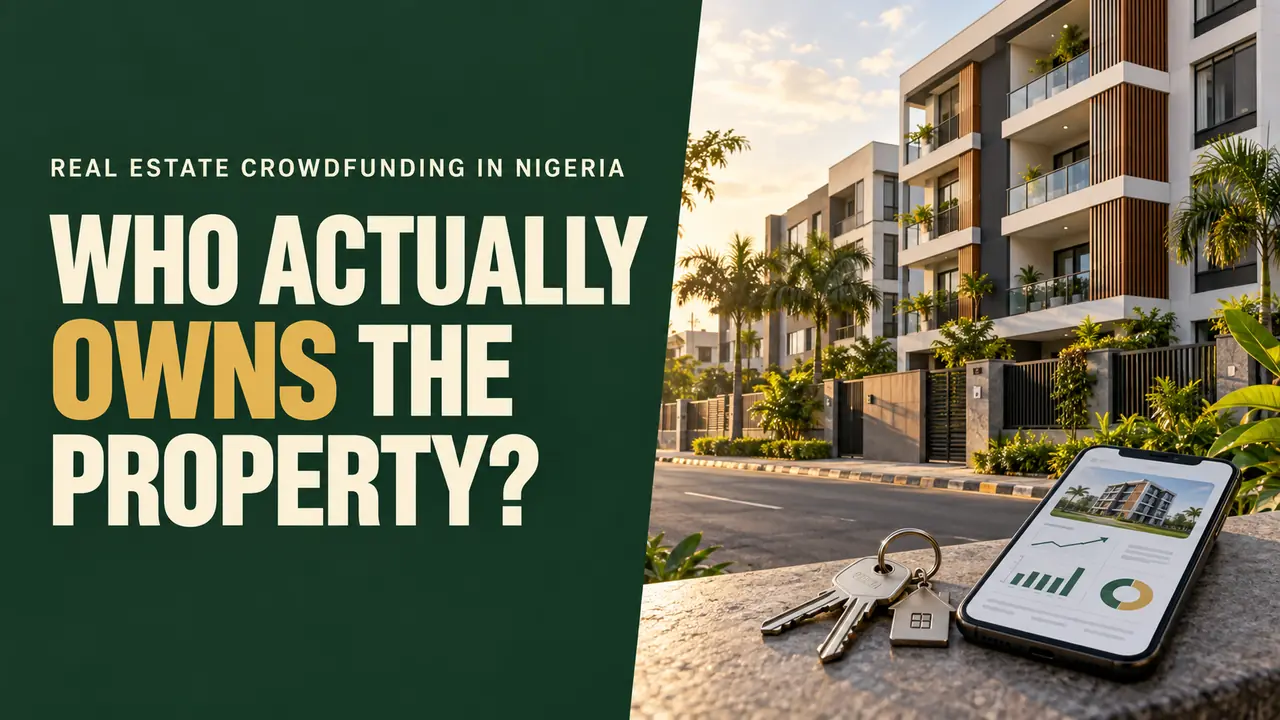
Real Estate Crowdfunding Platforms in Nigeria: Who Actually Owns the Property?
You see an advert for a block of flats in Lagos, Abuja or Port Harcourt, and the platform says you can become a property owner with as little as ₦50,000 or ₦100,000. After payment, your dashboard may show units, a percentage and an expected return. It feels like you have bought a small part of the building. The language is simple, attractive and easy to believe. Yet the picture on your phone does not settle the legal question. Before putting money into any real estate crowdfunding offer, you need to know exactly what you are buying and whose name appears on the property documents.
The short answer is that the person or company named as the holder of the property interest in the relevant title and registration documents usually owns the property. In many crowdfunding arrangements, that owner is a special purpose vehicle, commonly called an SPV, or another company created for the project. The individual investor usually owns shares, notes, units or contractual rights issued by that company. The investor does not automatically own one bedroom, one square metre or one physical corner of the land. A platform can call an offer “fractional ownership,” but those words have little value unless the legal documents explain the fraction and the rights attached to it. The real answer is therefore found in the title, the investment instrument and the contracts, not in the advert.
Nigeria’s Securities and Exchange Commission treats investment-based crowdfunding as fundraising from the public through an online portal in exchange for shares, debt securities or another approved investment instrument. Its rules recognise instruments such as ordinary shares, plain bonds or debentures, and simple investment contracts. The rules also require a crowdfunding portal that facilitates this type of investment to be operated by an entity registered as a crowdfunding intermediary. This matters because real estate branding does not remove an offer from investment regulation. If members of the public put money into a project and expect profit from the work of a promoter, the arrangement may fall within the SEC’s crowdfunding framework. The Investments and Securities Act 2025 confirms the SEC’s position as Nigeria’s main capital-market regulator.
Several parties can appear in one transaction, and their roles are not interchangeable. There may be a crowdfunding intermediary operating the website, a fundraiser asking for money, an SPV holding the project, a developer doing the construction, a custodian receiving subscriptions, a trustee protecting investors, and a property manager collecting rent. An investor can easily assume that the platform owns everything because its name and logo appear on every page. In reality, the platform may only provide the technology, conduct checks, display the offer and administer communication. The developer may be building the property without holding the title, while the SPV may hold the title without managing the building. You should identify every party and understand what each one is legally required to do.
The platform itself is often the least important name on the property title. Its main business may be matching investors with fundraisers and processing the investment through an online portal. Even where the platform is properly registered with the SEC, that registration does not mean the platform owns the advertised land or guarantees the project. Regulatory registration is evidence that the intermediary has met certain requirements, but it is not a government promise that investors will make a profit. The SEC has warned the public about dealing with unregistered crowdfunding platforms, so checking registration is a necessary first step. It should never be the last step.
An SPV is one of the most common structures used for a single property or development. Imagine that a promoter incorporates Lekki Homes Project Limited and transfers the relevant land interest to that company. Investors then buy shares in Lekki Homes Project Limited through the platform. In that arrangement, the company owns the property, while each investor owns shares in the company. Nigerian company law treats an incorporated company as a legal person separate from its shareholders, so the assets of the company are not the personal assets of each shareholder. If the title is genuinely registered in the SPV’s name, you have an indirect economic interest through your shares, but you cannot walk into one of the flats and claim a room as your personal property.
Shares can still give an investor valuable rights, but those rights depend on the documents. They may include a right to dividends from rent, a share of the proceeds when the property is sold, voting rights on major decisions and a residual claim if the company is wound up after paying its debts. They may also be restricted shares with weak voting power, limited information rights or no practical market for resale. A dashboard showing that you own 0.05 per cent of a project is not a substitute for your name in the company’s register of members. You should know the class and number of shares allotted to you, the amount paid, and the rules governing those shares. You should also receive proper evidence that the allotment has been recorded, rather than relying only on an email receipt.
Some property offers are loans dressed in the language of ownership. The investor gives money to a developer or project company, and the issuer promises to repay the capital with interest after twelve, eighteen or twenty-four months. In this structure, the investor is a creditor, not a shareholder and not a landowner. The phrase “property-backed” may only mean that the loan is connected to a property project. It does not prove that a legal mortgage or other enforceable security has been created over the property for investors. Unless the security documents clearly say so and the necessary registration has been completed, the investor may simply hold an unsecured promise to pay.
Another structure gives investors a contractual share of rent, sale proceeds or development profit. The platform may describe it as co-investment, profit participation or fractional participation. Under the SEC rules, a simple investment contract can exist where investors provide capital, promoters control the enterprise and investors share in its earnings or profit. This arrangement can provide an enforceable economic right without giving investors direct title to land. Your position will depend on the contract, including how profit is calculated, when payment is due and what happens after a loss. If the contract is silent on ownership, you should not assume that a promised share of profit also gives you a share of the property.
A trustee or nominee may also hold assets or security for investors. In a properly structured trust arrangement, the trustee can hold legal title or a security interest, while the investors have beneficial rights under a trust deed. This can make administration easier because hundreds of names do not have to appear on one land document. It can also give investors a single representative to enforce security when the issuer defaults. However, the word “trustee” on a website does not create a trust by itself. You need to see the trust deed, confirm the trustee’s identity, understand the assets covered and check whether the trustee can act without waiting for permission from the platform or promoter.
Direct co-ownership is possible, but it is less common in mass crowdfunding. Under a genuine direct ownership model, each investor’s interest should be supported by the property documents and the legal instrument creating that interest. The owners may hold undivided interests rather than separate physical portions of the building. This structure can become difficult when many investors must approve a sale, mortgage, lease or redevelopment. It can also produce disputes when one investor wants cash and others want to keep the property. If a platform says every investor directly owns the land, ask how that interest is registered and how decisions can be made without obtaining hundreds of signatures.
Some offers resemble a property fund or a real estate investment trust more than a single-building purchase. In that model, a fund, trustee or corporate vehicle owns a pool of properties, while investors own units in the investment vehicle. A unit gives an economic interest in the portfolio, but it does not make the holder the registered owner of a particular shop, warehouse or flat. Returns may come from rental income, asset sales and changes in the value of the portfolio. The investor’s rights are set by the trust deed, scheme documents or company constitution. This distinction matters when a platform uses photographs of one attractive building even though the money may be invested across several assets or projects.
The question becomes more serious when the crowdfunding money is meant to finance construction. A developer may be raising funds for apartments on land owned by another company, a family, a joint-venture partner or a government authority. The development agreement may give the developer permission to build without transferring ownership of the underlying land. If that agreement ends or the landowner challenges the project, investors can face a problem that no projected return on a dashboard will solve. You should ask what land right the project company holds and whether that right lasts long enough for construction, sale and repayment. You should also find out whether any existing lender, landowner or joint-venture partner can take control of the project before investors are paid.
Property ownership in Nigeria must be checked through the relevant documents and the land registry for the state where the property is located. Depending on the transaction, the records may include a Certificate of Occupancy, a registered deed, a Governor’s Consent, an allocation document, a survey plan or other evidence supporting the seller’s root of title. Lagos State, for example, provides official processes relating to title documents, regularisation and land registration through its land authorities. The exact document required will depend on the history and location of the land, so a colourful certificate should not be accepted at face value. A competent property lawyer should conduct an independent search and compare the registry result with the name of the proposed owner. That search should happen before funds are released, not after a dispute begins.
A Corporate Affairs Commission certificate proves that a company exists, but it does not prove that the company owns the advertised property. This is one of the easiest mistakes for a new investor to make. A promoter may show the SPV’s incorporation documents and present them as evidence that the investment is secure. You still need to check the title documents, because a company can be properly registered without owning any land or valuable asset. You should also search the company’s directors, shareholders and persons with significant control to see who ultimately controls it. The CAC Beneficial Ownership Register can help identify significant controllers, but that information must be considered alongside the land records and transaction documents.
The custodian has a separate role that is often misunderstood. SEC crowdfunding rules require the intermediary to appoint a registered custodian, and the custodian maintains a separate trust account for each funding round. Investor money should be held there and released only when the funding threshold and applicable conditions have been met. This arrangement helps prevent subscription money from moving straight into the promoter’s ordinary account before the offer closes. It does not normally make the custodian the owner of the land, and it does not remove development or title risk after the money is released. An investor should therefore ask both who holds the cash before closing and who holds the property after closing.
The offer document should state the legal identity of the fundraiser, the business plan, the use of the money and the exact instrument being offered. SEC rules also require a clear outline of investor rights and ownership of that instrument, along with financial information and other material disclosures. Read those sections before studying the projected return. If the document says you are buying ordinary shares, check the share terms and the SPV records. If it says you are buying a note or debenture, check the repayment and security terms. If it says you are entering an investment contract, read the clauses defining your profit right, loss exposure, voting power and exit route.
Security and payment ranking can determine whether the word “backed” has any real value. A bank that financed the development may hold a first-ranking mortgage or charge over the property. Contractors, tax authorities, employees and other creditors may also have claims that must be settled before ordinary shareholders receive anything. Retail investors holding unsecured notes can be far behind a secured lender if the project fails. Even shareholders in an SPV receive only what remains after the company pays its lawful debts. Ask for the security documents, the identity of the security holder and the order in which money will be distributed after a default or sale. If the promoter cannot explain the ranking in plain language, do not assume that every investor has an equal claim on the building.
You must also understand how the project is expected to make money. Rental income is not the same as sale profit, and a developer’s fixed repayment promise is not the same as either one. Rent can be reduced by vacancy, service charges, repairs, insurance, agency fees, taxes and poor collection. Sale profit depends on the final selling price, construction cost, market demand and the time needed to find a buyer. A headline return may be calculated before platform fees and project expenses, leaving the investor with much less. The offer should show the cash flow clearly enough for you to trace each naira from the tenant or buyer to your own account.
Construction projects carry risks that finished properties do not. The cost of cement, steel, labour, diesel and imported fittings can change sharply during the building period. Approval delays, contractor disputes, flooding, community claims and poor workmanship can also increase cost or stop work. When expenses rise, the developer may ask for more money, reduce the project scope or postpone investor payments. A fixed completion date in a brochure is therefore only useful if the contract states what happens when the date is missed. Investors should know whether there is a performance bond, adequate insurance, an independent quantity surveyor and a realistic contingency budget.
Exit is another point that deserves careful attention because property is not cash. SEC crowdfunding rules require prominent warnings that these investments are risky, investors can lose all their money and the securities may be difficult to sell. The rules also provide for a lock-in period of at least one year, subject to stated exceptions, but the end of that period does not create a willing buyer. A platform’s internal resale board can remain empty when many investors want to exit at the same time. A promoter’s promise to buy back your units is only as strong as the promoter’s cash and the contract supporting that promise. You should invest on the assumption that your money may remain tied down longer than the advertised tenor.
Valuation can also create a false sense of certainty. If a platform says a property is worth ₦500 million, ask who valued it, on what date and under what assumptions. An asking price is not a completed sale, and a developer’s estimate is not an independent valuation. A building under construction may be valued on the assumption that it will be completed, fully approved and occupied at a certain rent. If any of those assumptions fail, the amount recoverable from the property can be much lower. A sensible investor should compare the valuation with recent transactions in the area and consider how quickly the property could be sold during a difficult market.
Control matters just as much as ownership. If the SPV owns the property, someone still has the power to sign leases, appoint contractors, borrow money, mortgage the asset and approve a sale. Those powers may belong to directors chosen entirely by the promoter, even where outside investors supply most of the capital. The company’s constitution and shareholders’ agreement should identify decisions that require investor approval and the voting threshold for each one. They should also address conflicts of interest, related-party payments, new share issues and the removal of the property manager. Without these protections, investors can legally own shares while having almost no influence over what happens to the asset.
I become cautious when a platform avoids naming the company that owns the property. I also take warning signs seriously when the promoter refuses to provide a title search, uses “guaranteed” for an investment return, rushes people with a short countdown or accepts payment into an individual account. SEC rules prohibit a fundraiser from expressly or indirectly guaranteeing returns, which is important because no real estate investment is free from risk. Other warning signs include unexplained development fees, outdated valuations, missing audited accounts, vague exit terms and documents that use several company names without explaining their relationship. A professional platform should answer direct questions without hiding behind marketing phrases. If basic ownership information is treated as confidential, the investor should keep the money.
Consider a simple example involving a proposed six-flat building in Abuja. If Abuja Rental SPV Limited holds the valid property interest and you receive properly recorded ordinary shares in that company, the SPV owns the building and you own shares in the SPV. If you instead receive a two-year note from the developer, you are lending money and relying on repayment terms, even if the same building appears in the advert. If a trustee holds a registered security over the property for noteholders, you may have stronger recovery rights, but the trustee still needs the power and documents to enforce that security. If the promoter merely promises to share twenty per cent of future profit, your right may be contractual only. These four arrangements can use the same photographs and return figures while giving investors very different legal positions.
The difference becomes painful when a project fails. A direct owner may have rights connected to the registered property interest, while a shareholder must act through company law and the SPV’s governing documents. A secured creditor may ask the trustee to enforce the security, while an unsecured creditor may have to join other claimants and wait. A holder of a profit-sharing contract may recover only if the contract was breached and the promoter has assets available to satisfy a judgment. In every case, court action can take time and cost money. The best protection is not a promise that disputes will never happen, but a structure that clearly identifies the asset, the responsible parties and the available remedy.
Before investing, ask the platform to show you the title, the independent search report and the agreement through which the project company obtained its interest in the land. Ask for the SPV’s incorporation records, current ownership, directors, persons with significant control and register of members. Request the offer document and identify whether you are buying shares, a debt instrument, units or a contractual profit right. Confirm who holds subscription money, who holds the title, who can mortgage or sell the asset, and whether another lender ranks ahead of investors. Read the fee schedule, distribution order, default process, reporting obligations and exit terms. For a substantial investment, pay your own Nigerian property lawyer and, where necessary, a surveyor or valuer instead of relying solely on professionals appointed by the promoter.
Real estate crowdfunding can lower the amount needed to enter a property investment, but it does not remove the legal work that property ownership requires. The main question is not whether the platform calls you a co-owner. The main question is what legal instrument you hold and what asset supports it. If an SPV is on the title, the SPV owns the property and you may own shares in that SPV. If you hold a note, you are a creditor, and if you hold a profit-sharing contract, you have the rights written in that contract. Once you understand that distinction, you can judge the offer by its documents and protections instead of being persuaded by an attractive building and a percentage on a screen.
More to Explore


Comments (0)