
The Hidden Tax on Nigeria’s Informal Traders
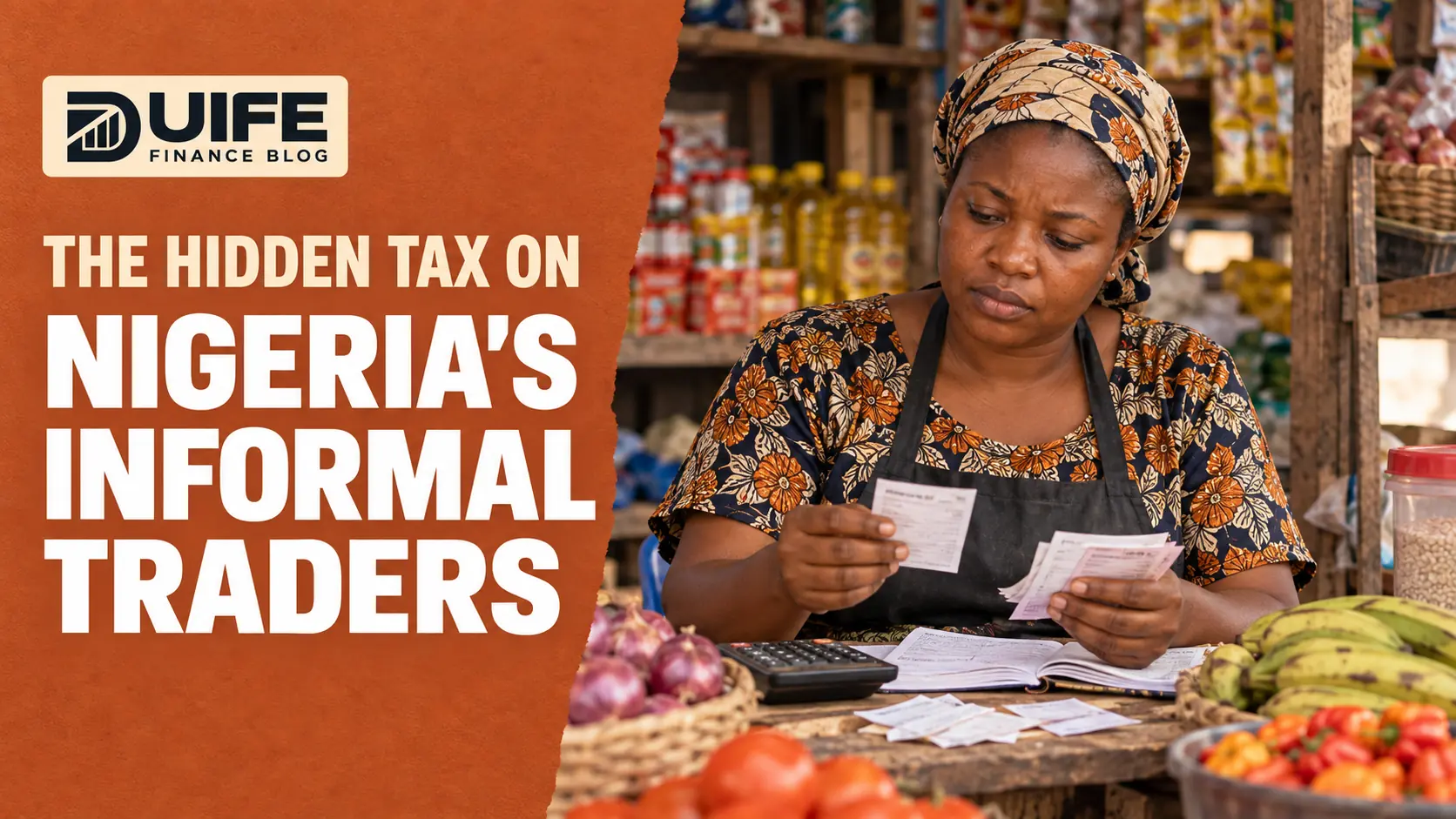
Imagine a woman who sells tomatoes in a busy Lagos market. Before she makes her first sale, she has paid for transport, loading, offloading and access to her selling space. Later, someone comes with a market ticket. Another person collects a sanitation fee. A market association representative requests dues. A local government collector may also arrive with a demand notice.
If she refuses to pay any of them, she risks an argument, the seizure of her goods or the closure of her stall. She may pay because she cannot afford to lose the trading day, even when she does not understand what the payment covers.
By the time she returns home, she may have paid several people without receiving one clear account of what she owed, why she owed it and which government agency authorised the collection.
This is the hidden tax on Nigeria’s informal traders.
Some of the payments are lawful taxes or government charges. Some are market association dues. Some are payments for services such as waste collection and security. Some are duplicate collections. Others are nothing more than extortion carried out by people who know that a trader cannot leave her goods to argue at an office.
There is another layer. Traders provide many of the services that taxes should help to fund. They buy petrol for generators because electricity is unreliable. They contribute money for private security. They pay to clear blocked drains. They repair damaged sections of the market and buy water for their shops.
These expenses are not taxes in the legal sense. However, they act like taxes because the trader has little choice but to pay them to remain in business.
The burden is easy to ignore because the payments are small and scattered. A ₦300 ticket does not attract the same attention as an annual tax bill of ₦100,000. But a trader who pays ₦300 every working day for 26 days has spent ₦7,800 in one month. If another collector takes ₦200 each day, the combined monthly payment rises to ₦13,000.
That amount can be a serious part of a small trader’s profit.
The official picture also shows how many Nigerians are exposed to this problem. The National Bureau of Statistics reported that informal employment accounted for 92.7 percent of employment in the first quarter of 2024. It estimated that about 92.7 million people were engaged in informal employment.
Informal employment covers more than market trading. It includes artisans, transport workers, food vendors, small farmers, domestic workers and other people whose work is outside a formal employment structure. Still, traders form a large and visible part of this economy.
The same report found that 84 percent of employed Nigerians were self-employed. It also found that women were more likely to be in informal employment than men. This means that the burden of unclear taxes and market collections often falls heavily on women who are supporting households through small businesses.
An informal business is not necessarily an illegal business. A woman selling provisions from a kiosk may be conducting a lawful trade even if she has not registered a company or hired an accountant. A mechanic can provide a legitimate service without operating through a limited liability company.
The word “informal” usually describes the structure of the business. The business may not be incorporated, may not keep complete accounts and may not have employees on a formal payroll. Its transactions may happen mostly in cash, and the owner may use one bank account for both personal and business expenses.
This structure makes informal traders easy targets. They often do not know the difference between personal income tax, a market levy, a shop permit, association dues and a sanitation charge. A collector can call almost any payment a government levy, print a ticket and rely on the trader’s fear of losing goods.
Not every small payment is illegal. Local governments and state agencies can collect certain taxes, rates and fees under the laws that apply in their jurisdictions. Markets may also charge for approved services. The problem starts when the trader cannot identify the law, agency, payment period or official account connected to the demand.
A ticket alone does not prove that a collection is lawful. Anyone can print a ticket. A genuine payment should have an authorised collector, a clear description, an amount supported by an approved schedule and a receipt that can be verified.
Association dues should also be separated from government revenue. If a market association collects money for security, cleaning, welfare or maintenance, it should state that the payment is an association charge. It should not present the money as a government tax unless the association has been formally authorised to collect it.
The difference matters because the routes for complaint and accountability are not the same. A trader disputing an association levy may need to approach the market leadership. A dispute over a state tax should be taken to the relevant state internal revenue service. A local government charge should have a responsible local government office.
When every payment is simply called “tax,” nobody accepts responsibility.
The hidden tax is also unfair because most market collections are flat amounts. A woman selling pepper from a small table may pay the same daily ticket as someone operating a large store. One trader may make a profit of ₦5,000, while another makes ₦50,000. A ₦500 charge takes 10 percent of the first trader’s profit but only 1 percent of the second trader’s profit.
This is known as a regressive burden. The smaller business loses a greater share of its income.
The effect becomes clearer when we separate sales from profit. Imagine that a trader buys goods for ₦45,000 and sells them for ₦52,000. Her gross margin is ₦7,000. She has not made a ₦52,000 profit.
If she spends ₦1,500 on transport, ₦500 on loading, ₦600 on tickets, ₦300 on transfer charges and loses goods worth ₦700 to spoilage, she is left with ₦3,400. A person looking only at the money entering her account may wrongly assume that she is earning far more.
This misunderstanding also affects formal tax assessment. Tax should not normally be calculated by treating every naira of sales as profit. The Nigeria Tax Act 2025, which took effect on 1 January 2026, allows expenses incurred wholly and exclusively in producing business income to be deducted when profit is calculated.
For a trader, these expenses can include the cost of goods, business rent, employee wages, repairs and other genuine costs connected to earning the income. The exact treatment depends on the expense and the trader’s circumstances, but the main principle is clear. Business income is not the same as total sales.
The trader needs records to prove the difference.
This is where many informal businesses face a problem. Purchases may be made without invoices. Transporters may not issue receipts. Daily workers are paid in cash. Personal withdrawals are mixed with shop expenses. At the end of the year, the owner knows that money entered and left the business but cannot produce a clear statement of profit.
The new tax law permits presumptive taxation where income cannot be properly determined or the person has failed to keep suitable records. Under this system, a trader can be assessed according to terms set in an applicable regulation instead of being taxed on properly documented profit.
This does not mean a revenue officer has the right to demand any amount that comes to mind. An assessment must still come from the proper authority and follow the law. However, poor records weaken the trader’s ability to challenge an amount that appears too high.
A simple notebook can provide protection. The trader can record the value of goods bought, daily sales, transport costs, shop rent, wages, damaged stock and official levies. Bank transfer receipts and photographs of paper receipts can be kept on a phone. A separate bank account or wallet for the business will make the records easier to understand.
The record does not need to look like the financial statement of a large company. It needs to show where the money came from, what was spent to earn it and what remained.
The 2026 tax rules also contain reliefs that many small business owners do not understand. An incorporated company that meets the legal definition of a small company pays companies income tax at zero percent. The law defines a small company as one with annual gross turnover of ₦100 million or less and total fixed assets not exceeding ₦250 million.
The Presidential Fiscal Policy and Tax Reforms Committee also states that qualifying small companies are exempt from the 4 percent development levy and from charging value added tax. These exemptions can protect genuine small businesses from taxes that would otherwise reduce their working capital.
A trader should not assume that every exemption for a small company automatically applies to an unincorporated sole trader. A limited company and an individual carrying on a trade are not taxed in the same way.
An individual trader is generally subject to personal income tax on chargeable income. Under the current individual tax bands, the first ₦800,000 of chargeable income is taxed at zero percent. Higher portions are taxed at the rates stated in the law. Chargeable income is calculated after the relevant business expenses, reliefs and eligible deductions have been considered.
This distinction is vital. A trader may have annual sales of ₦20 million and still have a much smaller taxable profit after paying for stock and other business expenses. Another trader with lower sales but a higher profit margin may have more taxable income.
A revenue collector should not look at a few bank alerts and treat the total as profit. The trader should also not assume that using cash makes the income invisible or removes the duty to comply with tax rules.
The current Personal Income Tax Guidelines issued by the Joint Revenue Board state that every taxable person should register and obtain a Tax ID. Individuals are also expected to file annual income returns, including people who may not have tax to pay after the available exemptions and rates are applied.
This is where many people become confused. Paying zero tax does not always mean that a person has no registration or filing obligation.
A trader who qualifies for a zero tax position can still keep records, file the required return and obtain evidence of compliance. The guidelines state that a taxpayer may qualify for a Tax Clearance Certificate even when no tax was paid because the person was exempt or fell within the zero-tax threshold.
That certificate can become useful when applying for a government contract, business loan, licence or other formal opportunity.
Informal traders often avoid registration because they fear that registration will expose them to endless demands. That fear is understandable when their daily experience involves aggressive collection and no clear service. But staying completely outside the formal system can also limit the business.
A trader without records may find it difficult to prove income when applying for a loan. The owner may be unable to separate business growth from personal spending. If goods are stolen, there may be no inventory record. If a tax dispute arises, there may be no evidence to challenge the assessment.
Formalisation should not mean turning a small roadside business into a large company overnight. It can begin with keeping records, obtaining the correct Tax ID, understanding the relevant taxes and paying only through approved channels.
The hidden burden does not end inside the market. Traders also pay costs that have already been added to the prices of their goods.
A truck carrying food from a farm may pay transport union charges, loading fees, local levies and unofficial payments at different points. The driver adds these costs to the transport price. The wholesaler includes them in the selling price. The market trader pays the higher wholesale amount, and the final customer pays more for food.
The charge may never appear on the trader’s ticket, but it is already inside the price of the tomatoes, onions or yams.
Bad roads create the same effect. Vehicles use more fuel, suffer damage and take longer to complete a journey. Perishable goods spoil before they reach the market. The trader pays for the loss through a higher purchase price or fewer goods available for sale.
Unreliable electricity imposes another hidden cost. A frozen food seller may pay for fuel, generator repairs and alternative storage. A barber buys fuel to operate clippers. A tailor pays for electricity from another source. These expenses reduce profit and raise prices.
Security also costs money. Traders contribute to private guards because they cannot leave their goods unprotected. They may pay for locks, metal doors and overnight storage. If a market fire or theft occurs, many receive little compensation.
These are business expenses rather than official taxes. Calling them hidden taxes is a way of showing that traders pay twice. They pay lawful public charges and then pay privately for services those public revenues should help provide.
The burden is made worse by the trader’s lack of time. A person operating a small stall cannot spend an entire day moving between a local government office, state revenue office and market association secretariat. Closing the stall to resolve a ₦2,000 dispute may cost more than the disputed amount.
Collectors understand this. Some rely on it. The trader pays because argument is expensive.
Government should make compliance cheaper than avoidance. Approved rates should be published at market entrances and online. The notice should show the collecting authority, purpose, payment period and official payment channel. It should be available in English and the main local language used in the market.
Collectors should carry verifiable identification. Payments should produce receipts that can be checked using a code, portal or official telephone number. A trader who has paid for a period should not be approached again by another group collecting the same charge under a different name.
Cash collection should be reduced. When a collector receives money directly, it becomes difficult to know how much enters the government account. Digital collection is not perfect, but it can create a record and reduce the opportunity for a collector to change the amount.
Market associations also have a responsibility. They should publish their dues, explain what the money funds and present accounts to members. A trader should be able to see whether a security contribution paid for guards or whether a sanitation payment funded actual cleaning.
Traders should never respond to every demand by fighting a collector. Markets can be tense, and goods can be damaged during a confrontation. A safer response is to request the collector’s name, identification, agency, written demand and official payment details.
The trader should keep every ticket and receipt. Where possible, a photograph should be taken immediately because small paper tickets fade or get lost. Traders in the same market can compare receipts to see whether the amounts and descriptions are consistent.
A demand that comes without a clear purpose should be questioned through the market leadership or the named government agency. If the issuing agency confirms that the collector is not authorised, the matter can be reported with the available evidence.
Nigeria now has a formal route for unresolved complaints. The Office of the Tax Ombud can review complaints about taxes, levies, regulatory fees and charges after the taxpayer has first used the complaint process of the relevant authority.
The law gives the office power to investigate complaints against tax officials and government agencies, recommend solutions and raise concerns about abuse of office. The service is not meant to determine how much tax a person owes, but it can address unfair procedures, harassment and administrative misconduct.
This route will only help informal traders if they know it exists and can use it without hiring an expensive consultant. Market associations, cooperatives and business groups should help members gather evidence and submit genuine complaints.
The wider reform is supposed to reduce multiple taxation. The Joint Revenue Board of Nigeria Act 2025 gives the board responsibility for promoting the harmonisation of taxes, levies, rates, charges and other payments across Nigeria.
That goal is necessary because the present burden is not caused only by high tax rates. It is caused by confusion. A trader may be willing to pay a fair annual amount but resist a system in which five collectors arrive with five tickets and five threats.
Harmonisation should produce fewer payments, one clear collection system and a proper division of responsibility between federal, state and local authorities. It should also stop government agencies from renaming the same charge to avoid restrictions on duplicate taxation.
Nigeria needs more people and businesses to comply with tax laws. Government requires revenue to provide roads, health care, security, education and other public services. But tax compliance cannot grow through fear and confusion.
A person who receives a clear assessment, pays through an official channel and sees how the money is used is more likely to comply. A trader who is harassed every week, receives no reliable receipt and still provides private electricity, water and security will view every collector with suspicion.
Informal traders also need to change how they see record keeping. Records are not only for tax officers. They help the owner know whether the business is making money.
A shop can look busy while losing money. Sales may rise because prices have increased, while the quantity sold and real profit are falling. Without records, the owner may confuse stock money with profit and spend money needed to replace goods.
Good records reveal the true cost of daily tickets, transport, waste charges, transfer fees and spoilage. They also show whether a collector’s demand would take an unreasonable share of the business income.
Nigeria’s informal traders are often described as people who do not pay tax. That description is incomplete. Many pay money almost every day. The problem is that much of it is fragmented, difficult to verify and disconnected from a proper assessment of their ability to pay.
Some traders may still owe lawful income tax. Some may fall within a zero-tax position. Some may qualify for small company exemptions if they operate through an eligible company. Their position should be decided through the law and proper records, not through the size of their stall or the opinion of a street collector.
The hidden tax will continue until every payment has a name, a legal basis, an accountable collector and a verifiable destination.
A fair system should allow a trader to know the full amount owed before opening the shop. It should prevent duplicate collection, recognise how small the profit margin may be and provide a quick way to challenge abuse.
The woman selling tomatoes is not asking to operate without rules. She wants to know which rules are real. She wants to pay the correct amount once, receive a valid receipt and return to her business without harassment.
That is not an unreasonable demand. It is the minimum standard of a tax system that claims to support small businesses.
Comments (0)