
Imagine that your salary enters your account on Friday afternoon. You receive the credit alert, open…
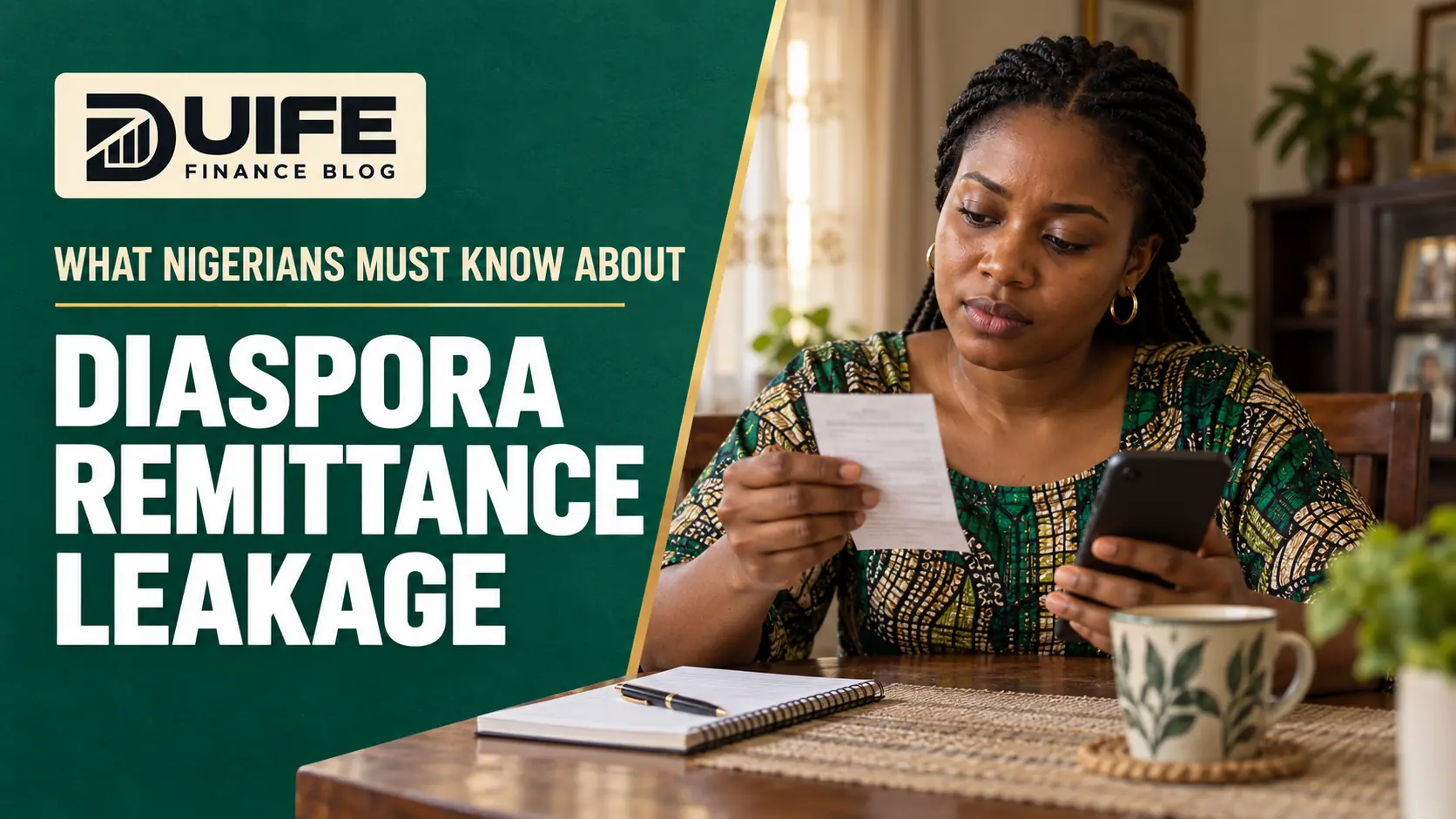
What Nigerians Must Know About Diaspora Remittance Leakage
Every month, Nigerians living abroad send money home to parents, siblings, spouses and friends. The money pays school fees, hospital bills, house rent, food costs and family debts. It also helps people build homes, start businesses and survive emergencies.
A woman in Manchester may send £300 to her mother in Ibadan. The transfer app advertises zero fees, the mother receives a naira alert, and everyone assumes the full value arrived. What they may not notice is that the company used a poor exchange rate. Another service could have delivered ₦15,000 or ₦20,000 more from the same £300.
That missing value is one form of diaspora remittance leakage.
I use remittance leakage to describe the money or financial value lost between the moment a sender pays for a transfer and the moment the recipient can use the funds. It can come from transfer fees, weak exchange rates, agent charges, failed transactions, fraud, unnecessary currency conversions and poor handling of the money after it arrives.
There is also a national side to the issue. When remittances pass through informal channels, they may not appear in official payment records. Nigeria still receives the economic benefit when the family gets the money, but the transaction becomes harder to measure. The foreign currency may also remain outside the formal Nigerian financial system.
These two meanings should not be confused. A payment that is missing from official records is not always money lost by the family. In the same way, money spent on food, rent or medical care is not wasted money. The concern is the avoidable loss that happens during the transfer or because of fraud, poor rates and weak planning.
The figures show why this subject matters. According to the World Bank’s Migration and Development Brief, Nigeria received about $19.5 billion in officially recorded remittances in 2023. That was about 35 percent of the total received by Sub-Saharan Africa.
This money is larger than the annual budget of many Nigerian states combined. It supports millions of households without passing through a government ministry or social welfare programme. When transfer costs remove even a small part of it, the total loss across Nigerian families becomes substantial.
The first place leakage occurs is the transfer fee. This is usually the amount a provider displays before the sender confirms the payment. It may be a fixed charge, such as £3, or a percentage of the amount being sent. Some services also increase the fee when the sender pays with a debit card, credit card or cash.
The fee is easy to see. The exchange rate margin is not.
A money transfer company buys or settles foreign currency at one rate and gives its customer another rate. The difference between the two rates becomes part of the company’s income. This is why a service can advertise a zero transfer fee and still be more expensive than a company that charges a visible fee.
Imagine that two providers are offering to transfer money to Nigeria. For the same total payment of £300, the first provider charges a visible fee but delivers ₦594,000. The second provider advertises a free transfer but delivers ₦580,000 because its exchange rate is weaker. The so-called free transfer costs the family ₦14,000 more.
These figures are only an example, not current exchange-rate quotations. The lesson is to compare the final amount that will enter the recipient’s account. The size of the advertised fee does not tell the complete story.
Before sending money, the sender should enter the same amount on two or three reputable platforms and check how many naira each recipient will receive. The comparison should be made at almost the same time because exchange rates can change during the day. The sender should also confirm that the amount shown is guaranteed until payment or is only an estimate.
Transfer costs remain a serious problem across Africa. The World Bank’s Remittance Prices Worldwide report for the third quarter of 2025 placed the average cost of sending $200 globally at 6.36 percent. The average for Sub-Saharan Africa was 8.46 percent, making it the most expensive receiving region covered by the report.
At an 8.46 percent cost, a household loses the equivalent of $16.92 from a $200 transfer. That may look small to someone earning dollars or pounds, but it can pay for food, transport, data or medicine in Nigeria.
The same report found that digital remittances were cheaper on average than non-digital transfers. However, digital does not automatically mean cheap. A polished mobile app can still offer a poor exchange rate. A new company can also use an attractive introductory rate and reduce it after the customer has become comfortable with the service.
Small and frequent transfers can suffer more leakage when a provider charges a fixed fee. Paying a £4 fee on a £50 transfer is very different from paying the same £4 on a £500 transfer. Families that receive regular support may reduce costs by agreeing on a sensible transfer schedule.
This does not mean that a sender should delay money needed for medicine or an urgent bill. Emergencies should be treated as emergencies. For normal monthly support, however, planning can prevent repeated charges caused by sending small amounts several times within one week.
The payment method also matters. Funding a transfer with a credit card may attract a higher fee than using a bank transfer or debit card. In some countries, the card issuer may classify the payment as a cash transaction and add another charge. The sender should check both the remittance company’s fee and any charge imposed by the bank or card provider.
Leakage can continue after the money reaches Nigeria. A recipient who must travel to collect cash will pay for transport and may lose several hours. A payout agent may try to impose an unofficial charge. Cash can be stolen, misplaced or spent without a clear record. A recipient may also receive one currency and immediately convert it again at a poor rate.
The correct payout method depends on the recipient. A bank deposit may be suitable for someone with an active Nigerian account. Cash collection may still be necessary for a person who does not have easy access to formal banking. The important point is to calculate the full cost, including transport, waiting time, withdrawal charges and any second conversion.
Delayed transfers create another type of loss. Money sent for a hospital bill or school deadline loses some of its usefulness if it remains pending for several days. A delay can also become costly when the recipient has to borrow money at a high interest rate while waiting.
Senders should look beyond the words “instant transfer.” They should check the normal delivery time, what happens during weekends, the process for correcting wrong details and how long refunds take. A provider that offers a slightly better exchange rate may not be the best option if it has weak customer support and holds failed payments for weeks.
Informal remittance channels often become popular when they offer a better rate than banks and licensed transfer companies. A Nigerian abroad may give pounds to an agent in London, while the agent’s associate pays naira from a Nigerian account. The foreign currency does not enter Nigeria through that transaction. The two sides settle their accounts separately.
The attraction is easy to understand. The transfer may be fast, the rate may look good, and the agent may be someone from the sender’s church, town union or social circle. Trust based on personal contact can make the arrangement feel safer than an unfamiliar financial company.
The problem is that personal familiarity is not the same as financial protection. If the agent disappears, delays payment or claims that the money was sent, the customer may have no clear complaint process. The transaction could also involve accounts linked to fraud, money laundering or other crimes without the sender knowing.
A person may receive naira from an unknown third party and later discover that the account used for payment is under investigation. This can lead to restrictions on the recipient’s bank account. The sender may also struggle to prove the source and purpose of the transfer because there is no proper receipt or transaction record.
This risk is higher when an agent asks the sender to split payments across several accounts, use a false payment description or avoid mentioning that the money is a remittance. Such instructions should not be treated as normal business practice.
Informal transfers also affect national records. If a Nigerian in Canada hands dollars to an unlicensed agent and a local partner pays the family from an existing naira balance, the transaction may not appear as an international remittance in the formal payment system. This makes it harder to know how much Nigerians abroad are sending home.
Official remittance figures should therefore be read with care. They show recorded transfers, not every dollar, pound or euro sent to Nigerian families. Cash carried by travellers, goods bought directly for relatives and transfers settled through informal networks may not be fully captured.
A wide gap between formal and informal exchange rates can push more people towards these channels. Senders naturally want their families to receive as much as possible. The World Bank has also noted that exchange controls and gaps between official and market rates can affect the channels people use.
Nigeria cannot solve remittance leakage by blaming citizens for seeking value. Formal channels must offer fair rates, clear charges, fast transfers and reliable complaint handling. If the legal route is expensive and stressful, people will keep looking for alternatives.
Fraud is another major source of leakage. Nigerians at home and abroad are regularly approached by people who claim to provide better exchange rates. Some operate through WhatsApp, Telegram, Instagram or community groups. They may complete a few small transfers to build trust before disappearing with a larger amount.
A common warning sign is pressure. The agent claims the rate is available for only a few minutes and asks the customer to transfer immediately. Another warning sign is a payment account bearing a name that has no clear link to the business. The excuse may be that the company account has reached its limit or is temporarily unavailable.
Fake payment evidence is also common. A sender may receive an edited receipt showing that naira has been transferred to the family. The recipient should check the actual bank balance, not a screenshot or text message. An SMS alert alone is not enough if the transaction cannot be seen in the account.
Recipients should never pay a “release fee” to obtain a legitimate remittance unless that charge was clearly stated by the regulated provider. They should not share a bank PIN, card number, one-time password or mobile banking password with anyone who claims to be processing an international payment.
Using a licensed operator does not remove every risk, but it provides a clearer level of accountability. The Central Bank of Nigeria maintains a public list of licensed International Money Transfer Operators. Before using a provider, Nigerians should confirm that it is authorised by the CBN and by the relevant regulator in the country where the money is being sent.
An app appearing in an online store is not proof that its remittance service is approved. A large number of downloads is also not a licence. Customers should check the legal company name because the brand displayed on an app may differ from the registered business name.
Price comparison should cover the complete transaction. The sender needs to know the total amount that will leave the account, the exact amount the recipient will receive, the exchange rate, the estimated delivery time, the payout method, the refund rules and the available customer support.
The best provider for a £50 transfer may not be the best provider for £1,000. Rates and fees can change according to the amount, payment method and destination bank. Nigerians who send money every month should compare services regularly instead of assuming that the platform they used last year remains the cheapest.
Both the sender and recipient should keep proper records. These include the receipt, transaction reference, recipient’s account details, exchange rate, fees and promised delivery amount. If the payment fails, these records make it easier to raise a complaint.
Names should be entered exactly as they appear on the recipient’s bank account and identification records. A nickname, spelling difference or incorrect date of birth can delay a transfer. If a platform asks for identification or proof of the source of funds, the sender should provide genuine documents through its official channel.
Know Your Customer checks can be frustrating, especially when money is urgently needed. However, trying to avoid them by using another person’s account can create a bigger problem. The money may be delayed, returned or frozen, and the real owner may find it difficult to prove a claim.
Sending money to a third party also weakens control. If a relative does not have a suitable account, the family should agree in advance on who will receive the money and keep evidence of the arrangement. Large payments should not be sent to a person simply because someone says, “I know him.”
This is especially important when diaspora money is being used to buy land, build a house or fund a business. Many Nigerians abroad have lost money because they trusted a relative to supervise a project without invoices, pictures, professional checks or written agreements.
A transfer can arrive without losing one naira to the provider and still be badly handled. A brother may say cement now costs more than expected. A contractor may request another payment without completing the previous stage. A person collecting rent may understate what tenants paid.
Large family projects need a basic control system. Payments should go to verifiable accounts. Receipts and invoices should be kept. Construction money should be released in stages after completed work has been checked. Property documents should be reviewed by an independent lawyer, not only by the agent selling the land.
For a business investment, the sender should know whether the money is a gift, a loan or an ownership contribution. This should be written down. Family relationships do not remove the need for records. In fact, clear records can prevent suspicion and quarrels.
Regular household support also needs a simple plan. The sender and recipient should agree on the main purpose of the money and the amount expected each month. If school fees or annual rent is approaching, the family can prepare before the deadline instead of relying on an expensive emergency transfer.
This planning should not become a way for the sender to control every meal bought in Nigeria. A person supporting relatives from abroad may not fully understand how quickly local prices change. The aim is to reduce waste and confusion, not to turn family support into an interrogation.
It is also wrong to describe every remittance used for consumption as wasted money. Food, health care, education and safe housing improve a family’s welfare. A hospital payment can protect a person’s life and earning ability. School fees can improve a child’s future.
Investment becomes relevant after urgent needs have been covered. If the amount is large enough, a family may agree to save part of it, reduce expensive debt or invest in a suitable asset. The decision should reflect the household’s real position. A family that has no food should not be shamed for failing to buy shares.
Naira devaluation can create another misunderstanding. When the naira falls, one dollar or pound produces more naira. The sender may believe the family is now much better off because the transfer delivers a larger number.
The number of naira is only one side of the matter. Food, transport, medicine, rent and school fees may have risen as well. If a £100 transfer once covered most of a month’s food but now covers only two weeks, the family has lost purchasing power even though it receives more naira.
Senders and recipients should therefore discuss what the money can buy, not only the amount shown in the bank alert. A household budget reviewed every few months gives a clearer picture than relying on an old transfer amount.
The pressure placed on Nigerians abroad also deserves attention. Many are paying rent, tax, transport and other bills in expensive cities. A relative in Nigeria may convert a salary in pounds to naira and assume the person is wealthy. That conversion ignores the cost of living abroad.
Poor communication can turn remittances into an open-ended obligation. Every family request becomes urgent, and the sender makes several unplanned transfers in one month. The repeated fees add up, while the sender’s own savings and debt payments suffer.
A healthier arrangement is based on honesty. The sender should state what can be afforded. The recipient should explain genuine changes in costs. Both sides should separate emergencies from expenses that can be planned.
Nigeria also needs a financial system that makes formal remittances worth using. Transfer prices must be easy to compare. Exchange rates should be clear before payment. Licensed operators should resolve failed transfers quickly. Customers should have a simple way to report unfair charges and fraud.
More competition can help, especially when digital providers reduce operating costs. However, competition only works when customers can see the real price. A provider should not hide most of its earnings inside an exchange rate while advertising a free transfer.
Banks and transfer companies should also explain their charges in language ordinary customers understand. People should not need to read several pages of terms to learn how much their family will receive. The useful figure is the final naira amount after every charge.
Diaspora remittances belong to the people who earned and received the money. Their main purpose is to support private households, not to solve every foreign exchange problem facing Nigeria. Still, reducing leakage benefits both families and the country. Families receive more value, regulated businesses gain customers, and more transactions can pass through formal records.
For me, the practical lesson is simple. A remittance should be treated as a financial transaction, even when it is sent out of love. Compare the final amount, check the provider’s licence, keep the receipt, confirm the payment in the recipient’s account and use proper records for large projects.
The missing ₦5,000 here and ₦10,000 there may appear small. Across repeated transfers and millions of Nigerian families, it becomes a serious loss.
The goal is not to stop Nigerians abroad from helping their families. It is to ensure that more of the money they worked for reaches the people it was meant to support.
More to Explore
Comments (0)